

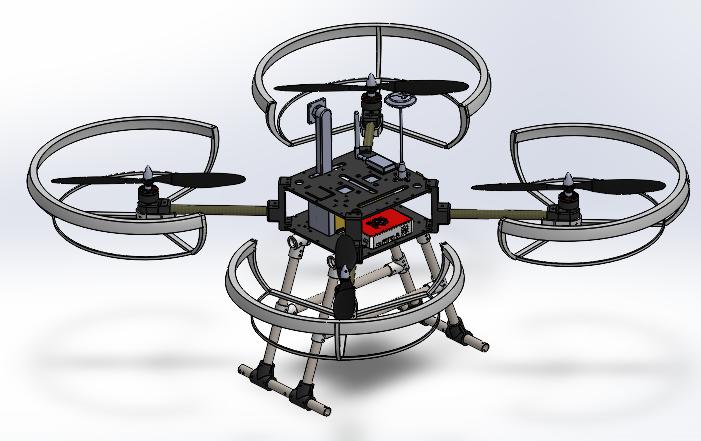
This project explores the design and development of an autonomous quadcopter drone system intended to improve the speed and reliability of emergency medical supply delivery. Traditional ambulance systems often face delays due to traffic congestion and limited accessibility, particularly in densely populated urban areas or remote rural regions. This engineering solution presents a scalable alternative that leverages drone technology to support time-critical healthcare delivery.
The quadcopter features a lightweight X-shaped carbon fibre frame with a 600 mm diagonal structure, capable of carrying a 1.5 kg payload. It includes a servo-based gripper system for secure transport and a temperature-controlled medical box integrated with Arduino-based sensors to maintain safe storage conditions. Powered by a 4S 5200mAh LiPo battery and Sunny Sky 800kV motors, the system achieves a thrust-to-weight ratio of 3.19 and up to 20 minutes of flight time. Autonomous navigation is enabled through a Pixhawk autopilot, Raspberry Pi 4B, GPS, IMU, barometer, and vision-based Aruco marker detection for precise landing and obstacle avoidance.
The system was developed using SolidWorks modelling, ANSYS structural analysis, Gazebo simulation, and real-world flight testing. Results confirmed stable flight dynamics and accurate GPS-based trajectory tracking. This work demonstrates the strong potential of integrating aerospace engineering, robotics, and AI-driven control systems within university-level innovation projects to address real-world healthcare challenges and improve emergency response capabilities.
10_RBOT_GDP8