

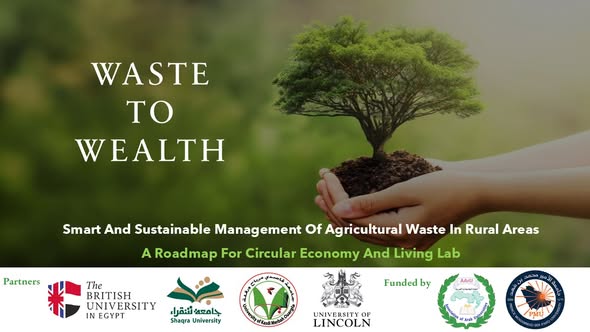
The British University in Egypt is demonstrating international leadership in measuring and gathering data for the Sustainable Development Goals (SDGs) through its award-winning, multi-partner research project focused exclusively on environmental sustainability and circular economy principles.
The project, titled “Sustainable Rural Agricultural Waste Management: A Roadmap for the Circular Economy and the Living Lab,” was recently honored with the prestigious Prince Mohammad Bin Fahd University Award for “Best joint scientific project between Arab Universities and international universities,” recognizing its excellence in innovative research that drives technological and sustainable advancements across the region and is funded through the Association of Arab Universities (اتحاد الجامعات العربية).
This initiative is a powerful example of international collaboration in action. The research is led by Associate Professor Noha Mostafa (Principal Investigator) and involves a diverse, multi-regional team of Co-Principal Investigators: Assoc. Prof. Mahmoud Abdel Daiem, Assoc. Prof. Hicham Siboukeur, and Assoc. Prof. Amira Elnokaly. The international academic partners include The British University in Egypt (Egypt), Shaqra University (Saudi Arabia), University Kasdi Merbah Ouargla (Algeria), and the University of Lincoln (UK). This combination of expertise ensures that the methodologies for data collection and the resulting measurements are robustly validated against varied global and regional standards.
The project’s central mechanism for both data gathering and real-world monitoring is the “Living Lab” framework. This is a functional, real-world setting where innovative strategies for managing agricultural waste are directly tested, refined, and monitored. By operating outside of a traditional lab, researchers collect tangible, quantifiable data on the effectiveness of circular economy solutions in practice. The data gathered provides crucial, on-the-ground metrics for measuring progress toward key SDGs.
Serving SDG 12 (Responsible Consumption and Production), data is collected on waste diversion rates, resource efficiency, and the successful transformation of waste materials into valuable products (e.g., “waste-to-wealth” conversion). The project also serves SDG 13 (Climate Action) where measurements focus on the reduction of greenhouse gas emissions by preventing waste from being burned or sent to landfills, providing evidence-based figures on climate mitigation impact.